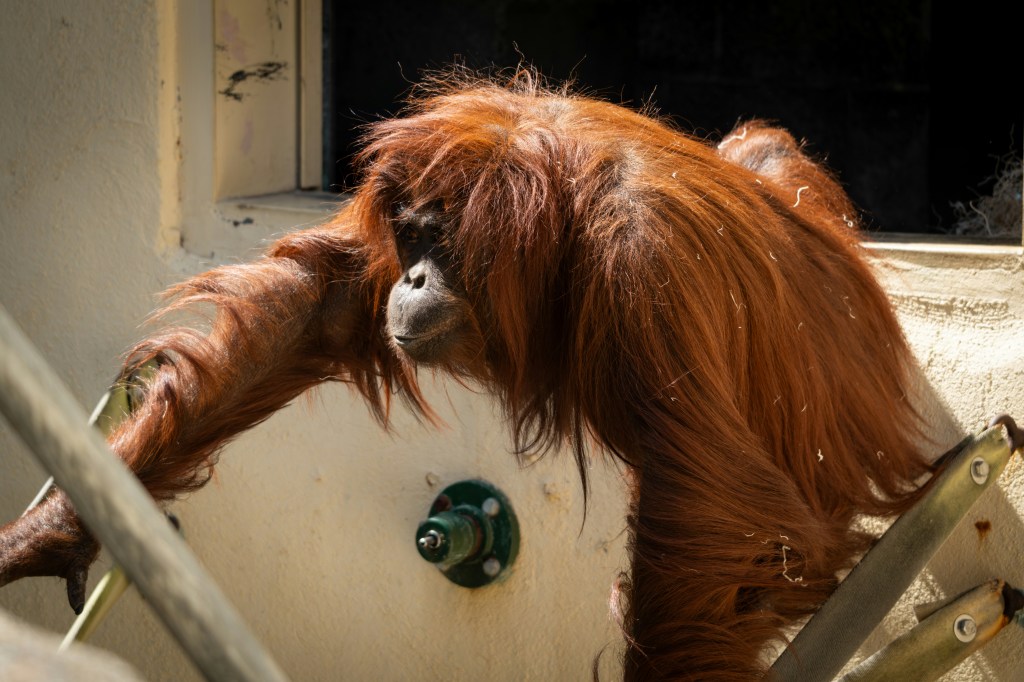
Somewhere after a bachelor’s in music, I found my way to animal behavioral studies. It went something like: finished a music degree but hadn’t found my passion; thought I might have an interest in ethnomusicology; took a cultural anthropology course; realized I’d found a subject that can teach us about human history on a scale I hadn’t encountered; took biological anthropology as my next lower-division course; decided that studying the roots of behavior through comparative animal studies is imperative to understanding our species.
As I was finishing Introduction to Biological Anthropology, I luckily found a job at a university so I could continue with upper-division classes through their staff reimbursement program. To complement that, I looked for additional ways to gain practical experience studying animals, and found a volunteer program at the Los Angeles Zoo. The first step in volunteering was completing an animal behavior class at UCLA, which I happily did, and where I learned random behavioral factoids such as the details of cricket fights. Then, after an orientation at the zoo and training with the behavioral research team, I was off with my clipboard and stopwatch in hand.
My once weekly shift at the zoo* started a little before it opened to the public in the morning, so I had the privilege of seeing many of the diurnal animals during one of their most active periods of the day, and when many were feeding.
*I feel it’s necessary to mention I have always felt conflicted about the place of zoos in society. The animals I observed had been orphaned, injured, or part of a culling that meant they would not have survived in the wild, and ideally all rescued wild animals would be in sanctuaries.
My job at the zoo, once I made it to the orangutan or elephant enclosure I was assigned to at the time, was to record each animal’s behavior every certain number of seconds through a detailed chart. The staff research team was interested in myriad topics all centered on helping these highly intelligent animals live the best lives possible under the circumstances. Each day, keepers placed new items in the enclosures called enrichment, a term for both the process of improving the daily lives of captive animals by providing mental and physical challenges, and the challenges themselves, such as toys, puzzles, and unique food delivery.
I once observed an orangutan fish food out of a tube using a stick he found in the enclosure, which was that day’s enrichment’s intended purpose. But then he used that same tube to reach through the mesh of the enclosure to try to trigger a release button he had seen the keepers use to lower food from a winch high above. Novel, and so smart!
Enrichment wasn’t just a nicety I observed, it was one of the only new things the animals encountered daily, beyond their interactions with any other animals around them. Enrichment helped the animals cope with the lack of environmental diversity they encountered daily, and after touring older, now defunct zoos, I’m thankful we no longer believe non-human animals can be healthy with no mental challenges and in simple cages. Likewise, our understanding of domestic animals has been evolving over time into a better realization of their needs. So what can zoo enrichment teach us about the environments we create for our animals in our homes?
At the zoo, I occasionally observed repetitive stress behaviors such as long-periods of pacing or chasing one’s tail (called stereotypic behaviors in pets) that were correlated with a lack of adequate socialization and/or a lack of environmental enrichment. Both are vital for animal well-being. For our pets, much if not all socialization comes from us, and that part of the equation is typically fun and easy! Spending time with them, showing them our world, and loving them becomes second nature. From the all important back or belly scratch for dogs to just sharing spaces, we become companions.
Enrichment too can be fun and easy if we make it a habit. For dogs, this means firstly the chance to sniff new things, ideally daily. And new doesn’t necessarily need to be a new walking path every day, but just the chance to smell how things have changed since the day before. Olfaction is a dog’s strongest sense, and preventing sniffing during a walk is the sensory equivalent of taking a human on a scenic walk while blindfolded. A ‘sniff walk’ provides some autonomy and cognitive problem-solving opportunities, and has been shown to help prevent boredom-induced destructive behaviors, as well as reduce overall baseline anxiety (Amaya et al., 2020; Duranton & Horowitz, 2019).
Shared games like fetch or tug-of-war, or hiding and retrieving treats, can also be fun ways to spend time together and give our pets mental challenges. Enrichment can also be feeder toys or puzzles that come with small treat rewards, or even moving toys that have been left out to new locations every so often so they’re encountered in a different context. And it doesn’t have to be costly to give our pets the mental stimulation they need. For instance, sometimes an open cardboard box is more fun for cats than the toy that came inside of it.
For owners of indoor-only pets, it can be more important to provide deliberate enrichment than our pets who accompany us outdoors. Their entire environment is the interior of our living space, and perhaps it says something about animals like domestic cats’ intelligence that they seem to find and explore every nook available to them. Buying new small toys occasionally and scattering them throughout the house can help give them new things to discover, plus provide entertainment as we watch them make the discoveries.
Of course there is a balance required between enrichment/mental stimulation and rest. At the zoo, I sadly sometimes saw animals turn their backs on zoo patrons as they called to them, or in the case of chimpanzees, display violently towards them. Likewise, our pets can be overstimulated if they’re in a constant state of activity or interaction. Animals need some agency within their days (Lotto et al., 2010). It’s helpful to have a routine that includes downtime, such as chances to rest or look out a window versus being by one’s side every minute. Providing some choice and autonomy gives our pets a degree of control over their lives, and can make them more confident, relaxed companions over time (Leotti et al., 2010; Špinka, 2023).
Ross (2006) shows that even micro-choices throughout the day can act as a buffer against chronic stress, empowering animals to self-regulate their emotional states. Micro choices we can give our pets include things such as choosing which direction to go on a walk, which toy to retrieve, or where to rest. From personal experience it’s important to note however that if you do let your dog give his or her input on walk direction, you should set a precedent that it’s more of a check-in than a tug-of-war or war of wills!
WHAT WE KNOW
Animals need more than food, shelter, and physical safety to thrive. Opportunities for exploration, sensory stimulation, social interaction, rest, and choice can all contribute to well-being. Enrichment can help animals engage in species-typical behaviors, solve problems, and interact with their environments in meaningful ways.
We also know that agency matters. Giving an animal appropriate choices, such as where to rest and what to investigate, can give them greater control over their environment and help buffer stress.
For our pets, enrichment doesn’t have to mean expensive toys or elaborate activities. A new smell on a familiar walk, a cardboard box, a game of tug, or simply the choice to wander off and nap can give an animal opportunities to explore and make decisions.
WHAT WE DON’T KNOW
We can’t ask an animal whether it’s bored.
We can observe behavior that suggests frustration, stress, under-stimulation, or a lack of behavioral opportunities, but we can’t directly access an animal’s subjective experience. A pacing animal isn’t necessarily bored, and a sleeping animal isn’t necessarily content. Even behaviors that look obvious to us can have multiple explanations. We also don’t know exactly how much novelty or stimulation any individual animal needs. Different species, and different individuals within a species, have different sensory, social, and cognitive needs.
Perhaps the most useful lesson I took from the zoo is that enrichment isn’t about keeping animals busy. It’s about giving them a life that contains opportunities to explore, choose, engage, rest, and be animals. That can be a useful thing to remember the next time your dog stops to sniff the same patch of grass for five minutes.
References:
Amaya, V., Paterson, M. B. A., & Phillips, C. J. C. (2020). Effects of Olfactory and Auditory Enrichment on the Behaviour of Shelter Dogs. Animals, 10(4), 581. https://doi.org/10.3390/ani10040581
Duranton, C., & Horowitz, A. (2019). Let me sniff! Nosework induces positive judgment bias in pet dogs. Applied Animal Behaviour Science, 211, 61–66. https://doi.org/10.1016/j.applanim.2018.12.009
Leotti, L. A., Iyengar, S. S., & Ochsner, K. N. (2010). Born to choose: The origins and value of the need for control. Trends in Cognitive Sciences, 14(10), 457–463. https://doi.org/10.1016/j.tics.2010.08.001
Ross, S. (2006). Issues of choice and control in the behaviour of a pair of captive polar bears (Ursus maritimus). Behav Processes, Jul;73(1):117-20. https://doi.org/10.1016/j.beproc.2006.04.003
Špinka, M. (2023). Animal agency, animal awareness and animal welfare. Animal Welfare 28(1):11-20. https://doi.org/10.7120/09627286.28.1.011


Leave a comment