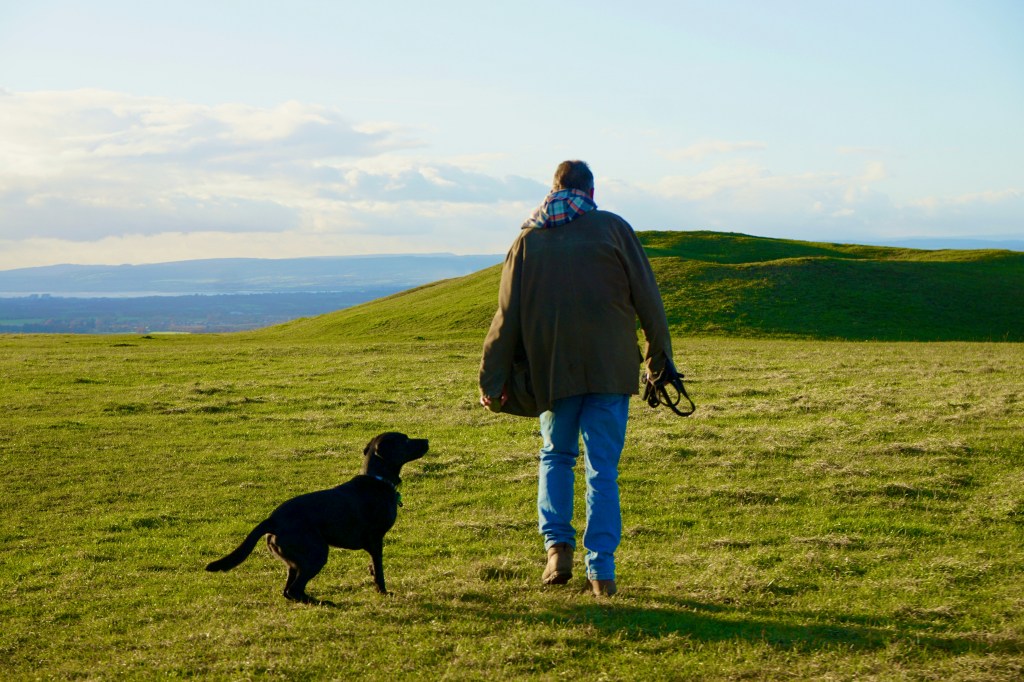
A quick web search on why dogs follow us around reveals a laundry list of pop-psychology answers: your dog has separation anxiety, it’s acting on ancient pack instincts, it’s bored, it imprinted on you in puppyhood, or it simply wants a treat. While these explanations offer quick comfort, they miss the deeper story. Beyond obvious triggers like treats or severe anxiety, popular culture does not give a coherent answer for this behavior, leaving the impression that science hasn’t truly unlocked why dogs shadow us.
To really un-pack this behavior (dog pun intended), we have to look past popular science and dive into evolutionary biology and canine cognition. First, a common misconception must be cleared up: domestic dogs did not evolve directly from modern wolves. Instead, dogs and wolves diverged from a shared, now-extinct ancestor between 15,000 and 40,000 years ago. Think of them as evolutionary cousins sharing a distant common grandparent.
This distinct evolutionary path has reshaped how dogs interact with human environments compared to wolves. A prime illustration of this cognitive shift has been demonstrated through the Object Choice Task: a common experimental paradigm in animal behavior research where a human gives subtle cues (such as pointing, gazing, or tapping) to indicate which of two containers holds food. When wolf pups not socialized with humans are subjected to this test, they look at the food containers and rely almost entirely on independent problem solving or trial and error. Conversely, young domestic dog puppies with minimal human interaction choose instead to read the human’s non-verbal gestures. Likewise, when faced with an unsolvable task like a locked food box, wolves try to break it open independently, whereas dogs look towards the human, effectively asking for help. Domestication didn’t just make dogs tame, it fundamentally rewired their social cognition to rely on human guidance.
This unique cognitive shift explains several key drivers behind why our dogs tend to trail behind us:
- Social Referencing and Information Gathering: Dogs treat humans as environmental compasses. Studies show that when dogs encounter a novel or ambiguous situation, roughly 83% engage in ‘referential looking’: glancing at their owner to read facial expressions and body language before deciding how to react (Merola et al., 2012). Following you ensures they stay synchronized with your emotional state and don’t miss critical cues about safety or an upcoming activity.
- The Secure Base Effect: Grounded in Attachment Theory, research confirms that the bond between a dog and its handler mirrors the relationship between a human infant and its caregiver (Thielke & Udell, 2019; Cimarelli et al., 2021). We serve as their secure base: a safe harbor whose presence provides the psychological safety they need to explore or relax in a world full of unpredictable inputs.
- Operant Conditioning and Resource Association: Dogs are masters of associative learning. In a typical household, human movement precedes positive outcomes, such as a door opening, a leash being taken out, a dropped piece of food, or a moment of affection. By staying in close proximity, dogs continuously position themselves to capture rewards.
- Evolutionary Drive for Interspecific Bonding: Domestic dogs possess genetic variations and neurobiological adaptations, including heightened sensitivity to oxytocin, that create a distinct hypersocial inclination toward humans (Wanser et al., 2019). Over time, they have become biologically predisposed to see us as their primary social partners.
Observing why a dog follows us serves as a natural entry point into deeper questions about human-dog coevolution and individual behavioral variation. In my articles going forward, I’ll attempt to separate empirical science from popular assumption through a framework of mapping some of what research confirms against open questions for further exploration:
WHAT WE KNOW
- Human Cue Responsiveness: Evolutionary history has equipped dogs with an extraordinary capacity to read human gestures and facial expressions, with studies showing they outperform wolves in interpreting non-verbal human communication.
- An interesting exception to this are wolves who’ve been reared around humans. Thinking back to the Object Choice Task, human-raised wolves have been shown to also be able to read simple pointing cues, though not as well in certain scenarios such as from a distance (Udell et al., 2012), and socialized wolves will not look at human faces for cues while domestic dogs will (Miklósi et al., 2003). This points to the complex interplay of biology and environment, a knot scientists are always attempting to untangle when determining the causes of behavior.
- Attachment Systems: Dogs form measurable attachment bonds with their owners. These bonds mirror caregiver-infant relationships, lowering a dog’s physiological stress markers when navigating unfamiliar environments.
WHAT WE DON’T KNOW
- Subjective Emotional Experience: While dogs respond to human distress, we’ve yet to prove whether a dog experiences empathy as humans define it, or if it is reacting to shifts in scent, body language, and/or learned behavioral loops.
- The Internal Monologue: We cannot say whether a dog trailing us into another room is actively calculating a future reward, or satisfying a deep seated impulse to maintain a baseline of physical closeness that comes with the biochemical reward of emotional attachment. (I know what I think, but my subjective experience as a dog owner is irrevocably biased.)
References
Cimarelli, G., Schindlbauer, J., Pegger, T., Wesian, V., & Virányi, Z. (2021). Secure base effect in former shelter dogs and other family dogs: Strangers do not provide security in a problem-solving task. PLoS ONE, 16(12), e0261790. https://doi.org/10.1371/journal.pone.0261790
Miklósi, Á., Kubinyi, E., Topál, J., Gácsi, M., Virányi, Z., & Csányi, V. (2003). A simple reason for a big difference: Wolves do not look back at humans, but dogs do. Current Biology, 13(9), 763–766. https://doi.org/10.1016/S0960-9822(03)00263-X
Merola, I., Prato-Previde, E., & Marshall-Pescini, S. (2012). Dogs’ social referencing towards owners and strangers. PLoS ONE, 7(10), e47653. https://doi.org/10.1371/journal.pone.0047653
Thielke, L. E., & Udell, M. A. R. (2019). Evaluating cognitive and behavioral outcomes in conjunction with the secure base effect for dogs in shelter and foster environments. Animals, 9(11), 932. https://doi.org/10.3390/ani9110932
Udell, M. A. R., Spencer, J. M., Dorey, N. R., & Wynne, C. D. L. (2012). Human-socialized wolves follow diverse human gestures… And they may not be alone. International Journal of Comparative Psychology, 25(2), 97–117. https://doi.org/10.46867/ijcp.2012.25.02.04 Cited by: 69
Wanser, S. H., Vitale, K. R., Thielke, L. E., Brubaker, L., & Udell, M. A. R. (2019). Spotlight on the psychological basis of childhood pet attachment and its implications. Psychology Research and Behavior Management, 12, 469–479. https://doi.org/10.2147/PRBM.S158998


Leave a comment